Young Writer Writes,
I recently started writing about a year ago. All my friends say i have really good ideas but I keep hitting a wall. I plan everything out but for some odd reason at like 35- 50 pages i run out of ideas....It is very frustrating... :/ Do you have any advice?
Dear YW,
This malady is common in writers, old and young, and it may happen for several different reasons. You may find my earlier post on Writer’s Block helpful.
If you run out of plot before your novel is of publishable length, you may be writing a short story. There may not be enough characters and conflict to warrant a novel-length work.
If you want to write a novel, you will need to introduce more conflict, characters, and subplots. New writers tend to be very linear in their thinking. This is the character, this is the problem, and this is what happens. It doesn’t take much space to deliver that kind of story. In writing a first draft, allow your mind the freedom to create connections and conflicts that you hadn’t anticipated or planned at the front end.
Play the “what-if” game. What if, in addition to being besieged by wizards at home, Raisa’s mother plans to marry her off as soon as she turns 16 to a suitor who might cause a civil war? Plus, the young soldier Raisa is in love with is ignoring her, and the ambitious prince of a neighboring country is threatening to invade?
What if Jack’s aunt actually turns out to be….
Consider yourself—your life is full of dramas, big and small. Consider your friends. They all have their own agendas, relationships, conflicts, and desires.
Layer those other conflicts and subplots onto your skeleton of story in order to flesh it out.
Here are some examples:
In addition to being the last of a guild of magical warriors being hunted by wizards to play in a magical tournament to the death, Jack’s girlfriend just broke up with him and the town bully is out to get him, and he doesn’t get along with the principal at the high school, and he doesn’t know if he’s going to make the soccer team. –The Warrior Heir
Not only is Seph a wizard who can’t control his powers, he’s been booted out of every school he’s attended, he’s an orphan who has recently lost his foster mother, and he’s responsible for the death of a friend. –The Wizard Heir
Madison Moss wants to be an artist, but there’s no money for college and her mother is flighty and irresponsible, leaving Madison to care for her younger siblings. A local coal company wants to force her off the mountain she loves. Plus Madison is thought to be a witch in her home town. –The Wizard Heir
More on this topic in my next post.
Saturday, January 23, 2010


Monday, January 18, 2010
Princess Central

So I’m at Walt Disney World, World Headquarters of princesses. There are many princess and princess-like characters on the prowl here. Little girls can sign up to attend special Princess dining events including Perfectly Princess Tea parties ($250 for two,) Princess Storybook dining and Cinderella’s Happily Ever After dinners.
Everywhere I turn, there are princesses in frilly yellow and pink and purple dresses with lace sleeves and flounces.


They even had pink and green camouflage princess caps.

Here’s the thing--I saw no princes at all. There are no prince luncheons—not even pirate beach parties or brigand barbecues, though you can dine with Mickey, Donald, and other Disney characters.
No wonder princesses have to hang with the rest of us—there does seem to be a prince shortage!
We take the Three Caballeros boat tour through “Old Mexico” at Epcot. In the seat behind us a young pirate is wailing. “It’s all right honey,” his parents croon. “This isn’t one of those scary rides.”
Next to him sits his princess sister in fancy dress and face paint, singing along to the Caballeros.
“Hey,” I say, twisting around in my seat. “I usually don’t see princesses hanging out with pirates. This isn’t a kidnapping situation, is it?”
The pirate stops sniffling and stares at me.
“It’s more like the princess kidnapped the pirate,” Mom says.

My kind of princess.
Tuesday, January 12, 2010
The Problem with Princesses

When I was a girl, my mother made me a princess costume one year for Hallowe’en. I was a princess, and my sister was an angel (this likely represented some wishful thinking on my mother’s part.)
My princess costume was tasteful gray satin with cathedral sleeves and a velvet bodice, and included a tall, conical princess hat with a scarf flying from the top. I almost immediately lost the hat, but I wore the dress all through winter and spring. I wore that dress until I could no longer shoehorn my growing self into it.
In recent years I was a regular patron of medieval dinners. Did I dress as a serving girl, or even a member of the burgeoning middle class? Oh, no—why squander a perfectly good opportunity to wear princess bling? I mean, princesses rule. Or they should.
But in traditional tales, princesses are too often passive creatures: waiting for rescue by someone else; held captive in towers, and enchanted by witches (and not in a good way). The archetypical princess is beautiful, kind-hearted, delicate and swoony. They spend a lot of time dreaming of their one true love, who miraculously turns out to be a prince—or at least a knight who can be polished up.
When a knight wins a kingdom, a princess is thrown in to sweeten the deal. They are often the equivalent of the winner’s purse when it comes to valiant quests, witch hunts, etc.
Sometimes I find myself rooting for the witch.
Princesses should be powerful figures, yet so often they are not--in literature, drama, and film, anyway. These days we have fire fighters and police officers, not firemen and policemen. But there are no princepersons. Princess is one of the few jobs that have retained that gender-specific title—perhaps because princes and princesses have had very different roles. Princes make things happen; princesses have things happen to them.
One of the viewpoint characters in the Seven Realms series is a princess. I almost cringe when I have to say that in my elevator speech. No, not that kind of princess, I want to say. Raisa is a kick-butt princess, frustrated with the expectations and restrictions of court life. She is the heir to the throne, and she intends to seize control of her future and create change in her queendom.

For example, Raisa is attacked in an alley by a drunken assailant. After disabling him with streetfighting techniques, she presses a knife to her attacker’s throat.
“You touch me again, you arrogant Ardenine swine, and I swear on the blood of Hanalea the warrior, I will geld you. Do you understand?”

One of my readers described Raisa as a playgirl—and she is. Like many a princeling before her, she intends to play the field before she makes a political marriage. She is a cynic when it comes to love—at first, anyway.
NEXT: Princess Central
Tuesday, January 5, 2010
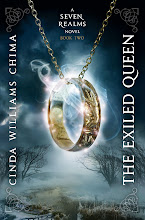
The Exiled Queen Coming September 28, 2010
I've been getting a lot of requests for information about the sequel to The Demon King. Since my website is under construction, I thought I would post a sneak preview here on my blogs.

This is the preliminary cover art. It will be used on the galley of The Exiled Queen, but is not the final version.
Below is a draft of the flap copy for The Exiled Queen. WARNING: If you've not read The Demon King, there be spoilers below! Proceed at your own risk!!
Haunted by the loss of his mother and sister, hunted by the powerful Bayar family, Han Alister makes a devil’s bargain with the clans. If they sponsor his schooling at Mystwerk Academy at Oden’s Ford, he will become their magical sell-sword against the power-hungry Wizard Council.
Han and his clan friend Fire Dancer undertake the dangerous journey south through war-torn Arden. Once in Oden’s Ford, it doesn’t take long for the smoldering feud between Han and Micah Bayar to kindle into flame. After several attempts on his life, Han knows he has to find a way to defend himself.
In the magical dream world of Aediion, Han meets the mysterious Crow, a wizard with a long-standing grudge against the Bayars. Crow offers to tutor Han in wizardry in exchange for his help. Han agrees, once again forced into a bargain he hopes he won’t regret.
Meanwhile, Han’s friends Fire Dancer and Cat Tyburn struggle with their own demons. Dancer is determined to become a clan flashcrafter, despite his charmcaster status. Cat carries a load of guilt, as the only survivor of the slaughter of the gangs in Ragmarket and Southbridge.
Resuming her disguise as gently-born Rebecca Morley, Princess Raisa ana’Marianna travels with her friend Amon Byrne and his triple of cadets to Wien House, the military academy at Oden’s Ford. There she hopes she will find both temporary sanctuary from a forced marriage and the education she needs to succeed as the next Gray Wolf queen.
Much of Raisa’s education takes place outside of the classroom. As she mingles with students of all classes from throughout the Seven Realms, she forges the kind of friendships that don’t happen amid the cut-throat politics of the Gray Wolf Court. She also struggles to deal with her attraction to Amon—an attraction he seems determined to discourage.
When Han Alister asks the girl he knows as Rebecca to tutor him, she agrees. The streetlord turned wizard with the complicated past fascinates her, and he makes it clear the interest is mutual. But Han blames Queen Marianna and the Bayars for the loss of his family. As their relationship deepens, Raisa suspects that if Han knew her true identity, he wouldn’t want anything to do with her.
Wednesday, December 23, 2009
On Day Jobs for Writers

A year or so ago I did a bookstore appearance in Frisco, Tx. An aspiring writer who’d friended me online was there with her mother. During the Q&A, the mom raised her hand and said, “Don’t you think that someone who wants to be a writer should also get a degree in a field where they can actually make a living? To fall back on, I mean?” During this, her daughter glared at her mother in a way that said, My life is over, and it’s your fault.
“Great,” I said. “There’s no way I can answer this without getting into trouble.”
Last week, a boy emailed me to say, “I’m in middle school, and I would like to be a writer when I grow up. Can you tell me, on average, how much writers make in a year?” The boy was planning ahead for poverty.
And then, recently, at a writing workshop, a mother told me that her eleven-year-old daughter was a talented writer. She asked for my advice.
“Well,” I said, “it’s great that she’s already writing. She should keep that up, and read as much as possible, too. And she should choose a career that will support her while still allowing her time and energy to write.”
The mother looked taken aback, like I was in the business of killing dreams and kittens. “Don’t you think that would be very difficult?” she said. “To try to write while working a day job?”
Well, yes, I thought. It is difficult. And exhausting. I speak from experience.
“I want her to be able to focus on writing,” the mother went on. “We’re more than willing to support her until she gets established.”
As if that wouldn’t be a high pressure situation.
I’m not exactly a model of career planning and efficiency. I mean, really—my first degree is in philosophy. Finding it difficult to secure employment as a philosopher, I took a post-bacc and master’s in nutrition and practiced as a dietitian for years.
I began to write, yes, as a second job, although in the beginning I could have worked retail and made more reliable money.
I recommend that beginning writers plan for a day job for several reasons. Firstly, of course, to buy food, shelter, Internet access, books, and subscriptions to writing magazines. Secondly, day jobs provide an alternative place to achieve those small successes that keep us going. Maybe you’ve just received your twenty-fifth rejection for a novel that took three years to write. But maybe you’ve also completed a fabulous project at work or seen understanding kindle in a student’s eyes.
Planning ahead may mean you can choose a career that doesn’t suck up your time and wring out your soul, leaving you in no condition to write. Professionals are better able to request flexible schedules and can make more money doing part time work. Some writers choose to work in a field aligned with writing—teaching English, say, or business writing. Others prefer the perspective of doing something completely different. For some, the day job is raising children when someone else in the household brings in an income.
Don’t overlook the fact that other careers can provide you with grist for the writing mill. Lawyers and doctors often turn to writing fiction and nonfiction related to their areas of expertise.
But the most important reason for having a day job as a writer is that it prevents the quest for money from killing your love of the craft. It allows you to enjoy your writing, to follow the muse wherever it takes you. It gives you the freedom to become the best writer you can be without feeling like you constantly have to hustle for a buck.
It’s bad enough to have your work rejected without facing eviction as a result. And it’s easy to devalue your writing when you are desperate for a sale and it’s not happening. There’s so much we don’t control about success as a writer. Talent and hard work are necessary but not sufficient for success. Desperation can squeeze the joy right out of your art.
That said, if you want to transition into writing full time, do your homework, set up a plan and work it. It also helps to marry someone with insurance.
I used to do a lot of freelancing, which brought in some money. I made a conscious decision to turn away from that and focus on novels, even though I knew there was a chance I would never make a dime. But I knew that freelancing would always be a part time gig. I could never make enough freelancing to leave my day job.
That was in 2002. My first novel was published in 2006. My fourth book is coming out this week.
I left my day job in May, 2008.
Friday, December 11, 2009
Dangerous Australia
There are no poisonous snakes in New Zealand, nor scorpions nor deadly spiders, either. That’s a plus, in my eyes.
 Australia is different—it is home to more poisonous snakes, frogs, spiders, lizards, stingrays, jellyfish, vertebrate fish, and other dangerous creatures than anywhere else on earth.
It’s become politically incorrect in the U.S. to demonize animals—even dangerous predators—as vicious killers. We even tend to romanticize businesslike kill-or-be-killed lifestyles. Nothing personal, but I’m above you on the food chain.
Australians, on the other hand, seem to embrace the dangers of life in the bush with relish.
It reminds me of the old Crocodile Hunter show—“These are the most DANGEROUS animals in the world!” And it was true in his case—he died of a stingray sting in the chest.
While in Sydney, I stopped in at Galaxy Bookstore, a specialty sci-fi and fantasy bookstore. I was chatting with one of the clerks, and said I was just beginning a tour of Australia.
“Watch yourself out there,” she advised me. “There’s lots of snakes.” Meaning, don’t let down your guard, even though right now you’re in the middle of a major metropolitan area.
Turned out she knows what she’s talking about. She’s specializing in reptile studies at university. Seems like a good field to go into down under.

We visited Sydney Wildlife World, which was teeming with deadly creatures—dangerous birds, snakes, lizards, insects—you name it. In case you missed anything, lurid warning signs highlighted the most dangerous creatures on display.
Not enough worries? Across the way was the Sydney Aquarium, displaying deadly denizens of the deep.
Whatever the topic, it seemed to stray onto deadly subject matter. The guide at the seemingly low-risk koala breakfast explained to us the difference between poison and venom. “Venom works through the bloodstream,” she said. “It’s injected. Poison, on the other hand, can be ingested in different ways. We can touch a poison frog, eat a poison mushroom, breath in poisonous gases or brush a poison plant. Got that?”

Remember the Foolhardy Family? They wouldn’t last a minute in Australia. Get past the fauna, and the flora and the terrain is dangerous, too—blistering deserts, unpredictable seas and shipwreck coasts, bottomless crevasses, unstable cliffs, and poisonous plants. Of all the rogue introduced plants, it seems the only ones that have caught on are the noxious ones.
 I’m a writer. My fertile imagination tells me there’s danger everywhere. I hiked through Alaska, singing at the top of my lungs, to drive off the bears. I walked through Florida wetlands scanning the underbrush for wolf spiders and alligators. I hiked through the “national forest” – ha! – desert in New Mexico, my eyes darting to either side, searching for rattlesnakes.Never thought I'd have to watch out for the lizard in the laundry room!
My advice: Watch yourself out there—it’s a dangerous world.

Monday, December 7, 2009
I'll be at Barnes & Noble Woodmere December 14!!

Subscribe to:
Posts (Atom)