Monday, February 16, 2009

Writer Rituals

I like hanging out with other writers. We usually begin by complaining about those things we CAN’T control—the price of necessities such as paper, ink, and food; the state of the publishing business; bad reviews or, worse, no reviews; rejection; spouses who expect that we actually make a living; and agents and editors who don’t put us at the center of their universe.
After we’ve worn that out, sometimes we discuss craft.
I like to ask my colleagues about their writing process, especially in those areas where we disagree (writer throw-down, anyone?)
I ask questions such as: Do you write in the early morning or the dead of night? Does your muse live at home, in a dedicated studio, at the beach, or at the local coffee shop? Do you write to music or demand silence? With or without chocolate? On the computer or in longhand on handmade paper? Mac or PC? Times New Roman or Courier?
Do you seek critique from others, or does early feedback kill your creative spirit? Do you like to travel in a pack or seek isolation?
Do you do extensive outlining and preparation before you sit down to write, or do you just launch, assuming it will somehow work out? Once you begin to write, do you write headlong, barely pausing to eat or sleep, or do you write for two hours and quit for the day? Is your daily word count 250? 500? 1000? 2000? Do you measure your progress in pages? Words? Time? Pounds of cashews?
When you revise, do you edit their original draft, or rewrite the thing entirely from the first paragraph? (that notion gives me the shivery-shudders, but that’s just me). Do you write the entire piece, and then revise? Or revise as you go?
Do you look forward to sitting down in front of your computer—hand-stitched journal—audio recorder—private stenographer—to write, or is it actually painful? Do you have to be “in the mood” or do you create your mood by forcing the issue, by sitting down and getting your hand moving?
Ask a few dozen successful writers the answers to these questions, and you’ll get many different answers. There is no one right way to write, and very few unbreakable rules. The wisdom of other writers can be helpful to you—but writing by its nature is a solitary endeavor. Each person has to find her own best method, and her own true path.

Sunday, February 1, 2009

Hard Words


This weekend I’m thrilled to be at Kindling Words, a retreat for published authors, illustrators, and editors in Essex Junction, Vt. Nancy Werlin is leader of our author strand, and last night the noted author and illustrator Ashley Bryan was our keynote speaker.
Mr. Bryan read poetry, particularly some pieces by African-American poets. He read a poem by Eloise Greenfield, from her book, Honey I Love and Other Love Poems. I didn’t catch the title, but the gist of the poem was, I bought some candy, and now it’s gone, I built a sand castle, and now it’s gone, I wrote I poem and I still have that!
It reminded me of an epiphany I had recently when we visited the Morse Museum in Winter Park, FL. The Morse houses the country’s largest collection of Tiffany art glass and paintings.
Now, I’ll tell you right now—I’m into gaudy. And I mean gaudy in a good way. Those brilliant, layered, leaded, folded, enameled, iridescent glassworks give me goose-bumps. Not to mention the jewelry that grabs you by the throat and makes you take notice. I also love the idea that everyday objects can and should be beautiful, that all art shouldn’t be sequestered away in museums where you can’t get at it when you need the lift that fabulous art and design can provide.
There were photographs of interiors of homes Tiffany designed and decorated, including commissioned works as well as the family mansion in New York City and his estate, Laurelton, on Long Island. Some of the rooms were too busy to sleep in, but there was extravagant attention to detail.
The sad thing is, most of those buildings have since been burned or demolished. Much of the artwork at the Morse was rescued from torn down homes, churches, and public buildings.
And I was struck by the ephemeral nature of beautiful things, natural and man-made. Of course, there are beautiful natural and man-made wonders thousands and millions of years old. But when beautiful buildings and natural wonders get in the way of what we call “progress,” we tear them down. Hurricanes come through, and knock them down.
We writers deal with intangibles. Most people would consider words to be less substantial, say, than marble pillars. But both words and music are durable. They can be captured and preserved in myriad ways (more ways all the time).
That’s the wonder of great books and beautiful music: they can create beautiful imagery over and over again in the minds and hearts of people around the world. Of all the arts, they are renewable. The summer night or the broken panel of glass can’t be retrieved, but they can be recreated in the mind through music and prose. We can enter the garden any time we want by turning the page.

Tuesday, January 20, 2009

Come to a Teen Fantasy Writing Workshop in Akron!!


Northwest Akron Branch Library
Tuesday, Feb. 3, 2009, 4-5 p.m. 
1720 Shatto Avenue, Akron, Oh 44313
(330) 836-1081

I'm presenting a Fantasy Writing Workshop for teens at the Akron-Summit County Library Northwest branch. If you live in Northeastern Ohio and you've always wanted to try your hand at writing fantasy, contact Erin Murphy, Teen Librarian for details at emurphy@akronlibrary.org  Hope to see you there! 

Sunday, January 18, 2009

The Difference Between Writers and Engineers

I recently travelled with my husband to an aerospace meeting in Orlando as an “accompanying person.” This is the new politically correct term for what used to be called “spouses” or even “wives.”
This prompted my agent to ask whether I could be both an “accompanying person” and an “interesting person” (see previous post.) And I said, yes, of course, I’ve always been good at multi-tasking.
I attended the “accompanying person” breakfast, which was also crashed by a few savvy actual meeting participants. I soon became convinced that it is far better to be an “accompanying person” than an participant in the conference. There are none of those pesky meetings to attend nor presentations to deliver. No need to feel guilty about sitting in the hot tub at mid-day. No need to—gasp—put on dressy clothes in the Florida heat.


Workspace Provided for Accompanying Persons

Note to readers, agents and editors: I was, of course, working—writing and revising—the whole entire time.
Disclaimer: The following are my random, unscientific, oversimplified and probably totally skewed observations.

The aerospace meeting had a very different feel from the writers’ conferences I frequent. For one thing, most of the attendees wore shirts and ties and even suits and sports coats. Even the graduate students wore jackets. Fortunately, they were mostly men.
Dress at writers’ conferences is difficult to describe. People who commute from their kitchen tables to their dens are used to being comfortable.
Most neither need nor desire “business attire” nor would they put it on without a gun to their heads. Writer attire varies from Bohemian to bead-and-sequin extravagance, from punk and emo to retro hippie, from cutting-edge fashionable to suburban casual, from sweats and slippers to late thrift shop grunge.
Which is fine with me.
My view: It’s tough enough to be a writer without being required to wear neckties or hosiery.
As noted above, the engineers were mostly men. Writing conference attendees are of mixed gender except that conferences for children’s writers seem to attract a larger share of women.
During the aero conference, the food court at the hotel was packed each morning at 7 a.m. by conference attendees seeking breakfast before the 8 a.m. start time.
My experience has been that writers tend to slope in late, blinking like owls, with gigantic cups of coffee in their hands. So this is what 8 a.m. looks like.
One thing writers and engineers have in common—they tote around notebook computers.
I suspect that most of the engineers have good-paying jobs with benefits. Most writers long for good-paying jobs with benefits. Or spouses/accompanying persons with good paying jobs with benefits.
It might be interesting to plan joint right brain/left brain conferences for writers and engineers, complete with singles mixers for the unattached.

Wednesday, January 14, 2009

Never Good Enough

When I was in Florida recently, I visited the Charles Hosmer Morse Museum in Winter Park. It houses the largest collection of Tiffany art in the world. My husband is a stained glass artist, and we’ve been fans of Tiffany for years.
There was a display at the Morse focusing on Tiffany the artist and his life. Included in the exhibits was Tiffany’s “sketchbook” from his first visit to Europe in 1865 when he was sixteen. Titled, “My First Visit to Europe,” it contained beautiful pencil sketches of such scenes as “Arab with Reed Instrument,” “The Baths of Caracalla—Rome” and “A Street in Chester, England.”
Let me repeat—the boy was sixteen. Maybe seventeen.
I always get depressed when I see someone else’s finely-crafted journal or scrapbook. I can create images with words—period. And never perfect the first time. If ever.
My mother-in-law used to create these beautiful scrapbooks with photographs and hand-drawings and calligraphy and give them out to family members and friends. My friend Jan is a talented writer, artist, and papermaker, and her journals are exquisite records of her life.
Me, I have journal envy. My handwriting is abysmal, I can’t write in a straight line, and only the advent of computers saved me from a lifetime of working with stencils. (I bet about half of you don’t even know what stencils are).
Jan gave me this beautifully-crafted journal with handmade paper. And I’ve yet to write anything in it. Nothing ever seems good enough. I’ll think, “This is a really beautiful journal, and I don’t want to waste it with inadequate and poorly-chosen words.”
So it never gets written in.
I so have to get over this. I so deserve to write in a beautiful journal, right? Right.
So I went into the museum gift shop, and they had beautiful blank journals with Tiffany’s autumn vine window on the cover. They were carefully hand-stitched, with creamy, thick pages that would soak up the ink. So I bought one, saying to myself, You are going to write in this.

Here is what I would like to say: And that’s just what I did. In fact, the essay you’re reading right now was written in that book I bought at the gift shop.
But, no. I lied. I wrote this on the computer so it’d be easy to edit. Multiple times.

Sigh. Still not good enough…

Friday, January 2, 2009

I'm Interesting!


I have been named to Cleveland Magazine’s Most Interesting People 2009 list, along with an Indians pitcher, a shoe artist, an actress, and sundry other folk. Get the details here: http://www.clevelandmagazine.com/ME2/ Click on the Most Interesting People link. And, uh, that’s not me on the cover.

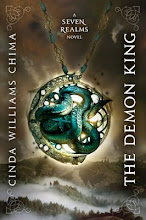
My webmaster has been hard at work over the holiday season, and you can see the results at my Website. Visit the new Demon King page for links to the first chapter, a history of the Seven Realms, tables of characters, language, etc. Hopefully those tools will be helpful to readers when they actually get the Demon King in hand in October. Let me know what you think.

http://www.cindachima.com/Demon%20King/Demon%20King.htm


Thursday, January 1, 2009

Resolution 2009

I've never been good about the due diligence involved in having a life. By that I mean those boring, detail-oriented maintenance things that have to be done over and over and that you never get credit for. No one will ever walk into my house and say, “Whoa!! This place is staggeringly clean!” Or check out my desk and say, “How do you keep things so organized and tidy?”

            I have the labeled file folders, I just don’t always put anything into them.

            Here’s another example. I love gardening. I love picking out cool plants at the garden store and shoehorning them into my yard. I plant perennials, which are about as low-maintenance as gardening gets. But I don’t do the lift and divide thing and the thinning out and weeding thing and the clip off the spent blooms thing. So my garden is a chaotic battleground—a survival of the fittest. Usually weeds.


See? I have the theory down. I just can’t seem to fit the process into my life. Or don’t want to.

I think of myself as an idea person. I’ve mastered the use of the matrimonial “we.” Like, “Why don’t we plan a trip to Australia?” Or, “Why don’t we invest in an index fund?” Or, “Why don’t we build a sunroom?” And then I wait, hoping that my long-suffering spouse will take on the project. And he usually does.

He’s really good at it, and I know my limitations.

            That said, there are many maintenance tasks that go along with writing. An investment of time can both improve your writing and make your writing life more successful. Examples include reading about craft and the business of writing, planning projects before the launch, developing and honing computer skills, and keeping good records, financial and otherwise. It’s also important to maintain your blog, update your Website in a timely manner and network with other writers, librarians, teachers, and publishing people. Not to mention reading voraciously in the genre you’re working in.

            Mind, sometimes writers use those kinds of maintenance tasks to avoid writing altogether. They are so busy picking out wallpaper for the writing studio, reading books on craft and attending workshops that they never actually get down to business.

Not me, not usually. As soon as I finish one writing project I tend to charge headlong into the next, ready or not. I blame this on habits forged during a lifetime of working two full-time jobs and raising and neglecting children. Have a minute? Write a page or two.

In May I quit my day job. I’m still trying to re-allocate my time, to get over the notion that I have to write every minute.

At Christmas, I received a new Macbook. I have not written anything for an entire week. Not counting this blog. Instead, I have read the manual and attended workshops. Downloaded software. Fondled the keyboard and examined the drop-down menus. I’ve considered how this tool might expand my reach and sharpen my delivery.


I have also developed and refined a table of characters, places, and terminology for my new high fantasy trilogy. Redrew a map of the Seven Realms where the action takes place. Written a pre-history for the novels and selected photographs to illustrate setting. I have laid in bed, dreaming on my characters and what they’ll be doing in the next book.

I’ve answered scores of emails (I’m always pretty good about that) but I still have some snail-mail correspondence to catch up with.

My New Year’s Resolution: to develop a system for taking care of those other jobs in order to make my work and my writing life better. This includes making time for dreaming.