Tuesday, June 29, 2010

TOO WEIRD TO BE FICTION


I’ve been having this shoe problem. I buy my usual size, but now they seem to pinch my toes. My mother would say that it’s just my Appalachian roots surfacing—I can’t wait to get my shoes off in the summertime.
I know—TMI.
I decide to go to the shoe store and have my feet measured for size.
When I walk into the store, there is one clerk—a young man—and no other customers in sight. I tell him what I want and he measures my foot and announces that it is one size bigger than I thought it was.
“Really? You mean my feet are growing, at my age?” Maybe there’s still hope that I can cash in on that growth spurt I missed when I was twelve.
“They don’t really grow, they just kind of flatten out,” he says.
But I can tell his mind isn’t really on my foot problem. He keeps looking out the front of the store into the mall.
I look out there, too. “Um. Are you looking for someone?”
“I’m wondering where that guy ran off to,” he says.
“What guy?” I say, naturally enough.
“There’s another guy working, but he keeps disappearing.” The clerk fetches shoes for me to try on, then continues. “See the assistant manager’s not coming in until three. I want to make sure I’m gone by the time he gets here.”
“Oh,” I say. “Why?”
“Because he’ll come in crabby and then he’ll find something for me to do.”
“I can see why you’re worried,” I say.
“I’m not worried,” he says. “I know how to handle him.”
I choose a shoe, but I’m a little concerned about my heel sliding, so the clerk creates this kind of cats cradle of laces to strap the shoe to my foot. I examine it doubtfully.
“Don’t tell anyone I told you how to do this,” he cautions me. “If anyone asks, just say you came up with it on your own.”
By now I’m wondering if there’s anything in employee orientation about what not to tell a customer.
“One thing I like about working here is, I’m close to the cologne,” he confides.
I look around for cologne, and don’t see any.
“At Macy’s,” he explains. “I go over there and they give me things. Like the other day, they gave me an Axe leather duffel bag.”
“Oh,” I say.
“They give me all kinds of things. And now I have about twenty different kinds of colognes.”
“Must be hard to choose in the mornings,” I say.
He nods. “I have almost as many kinds of colognes as I have shoes.”
“I guess that’s another good thing about working in a shoe store,” I say.
“Oh, they’re not from here,” he says, taking my shoes up to the register. “They’re from Journeys.”

Quote of the Day: It's no wonder that truth is stranger than fiction. Fiction has to make sense.—Mark Twain

Wednesday, June 23, 2010

The Importance of Critique

When advising aspiring writers, I always suggest that they find a way to get feedback on their work. There’s only so far you can take your work all by yourself.
And better you deal with that adverb addiction or propensity for purple prose before your work goes to an editor or agent. They most likely won’t offer critique—they’ll just say no.
You may be tempted to send your manuscript to an author you admire and ask for feedback. But as I pointed out in a previous post, most authors simply cannot take this on.

That said, finding the right kind of feedback is easier said than done. First of all, you have to be honest with yourself about what it is you want. And then you and your critique partners need to be on the same page, so to speak. If you want somebody to tell you what a genius you are, well, there’s always Mom (you take after her, after all.)
If you want to improve as a writer, you’re looking for something a little more directive than that. Something that will let you know very clearly what is and isn’t working, without breaking your writer’s heart.
What is often overlooked is that critiquing other writers’ work and hearing other viewpoints and voices also helps you grow as a writer. One important lesson to learn, early on, is that readers bring their own tastes, skills, and sensibilities to the table. And that not everyone will connect with what you write.
More than that, writing is a lonely and potentially soul-shattering business. Spouses may be supportive, friends empathetic, but sometimes only another writer can understand what it’s like to receive a seven-page editorial letter on the novel it took you five years to write. Or have your heart’s work rejected for the sixteenth time. Or have an agent tell you, “I didn’t love it.”
They can answer those questions that begin with, “Is it just me or…?”
Only another writer knows that your troubles aren’t over when you find an agent; when you find a publisher; when your first book is successful.
Other writers can help you recognize and celebrate your successes—even if that success is a personal note from an editor or agent scribbled on a rejection. Your spouse may say, “Um. But it’s still a rejection, right?” Your critique partners will know that it represents progress along the continuum to publication.

I used to belong to a critique group that had a little Snuffleupagus totem we passed around to the writer who’d received the most humiliating rejection that month. For example, it might be the one who had been rejected by the publisher with the lowest standards, had received the most impersonal, crooked, multiply-copied form letter or the most caustic scribbled remark. Like the newspaper editor who scrawled, “I DON’T THINK SO, MRS CHIMA!!!” across the article I’d submitted on spec. Or the editor who told my friend, “If it were possible to publish everything, we would have published yours.”


In a future post: where to find critique.

Wednesday, June 16, 2010

Weather or Not


In different parts of the country, there are differing definitions of “bad weather,” depending on whether they actually have any. I mean, everybody likes to talk about the weather, right? Some of us just have more to talk about.
Where I come from, it’s not bad weather unless we can shovel it. Or unless trees are coming down around our ears. We take pride in our bad weather, the summer and winter storms that roll in off the Great Lakes. “Yep, I remember the blizzard of ’78. It was so cold we had to wrap up in snowdrifts to keep warm. It was so windy, the barn blew inside out and we had to staple the cows to the roof.”
California may have its Santa Anas and the Mediterranean its Mistrals and Sciroccos, but here on the North Coast we have the witch of November—the gales that sink ships on the Great Lakes.
We also have something called “lake effect,” where the Northwest winds pick up Lake Erie and dump it on our heads in the form of rain, sleet or snow.
In some parts of the country, if you predict “sunny and hot” you’ll be right ninety per cent of the time. Where I live, weather is a big deal. We treat our meteorologists like shamans (shamen?) and hang on their every word. Sometimes they are woefully wrong, but we forgive them. Predicting the weather around here is hard.
In the midwest, we’re good at coping with bad weather. The birth rate always skyrockets nine months after a big snowstorm or a power outage. I’m just sayin’.
My husband and I went on our first date during the Great Fourth of July storm of 1968. Um. We were—um—in preschool. The fireworks were called off, the trees came down, we went back to the house, and a great romance was kindled that  still burns today.
A couple of years ago I was in LA for the SCBWI Summer conference. The conference buzzed about the bad weather. It was raining.
“Maybe you’d better leave for the airport early,” people said, in the hushed, excited tones we reserve for the hundred-year storm. “There’s no telling what the traffic will be like.”
I was in San Antonio, Tx, last February, at a time that Mother Nature was relentlessly dumping snow on the Midwest.  People in SA were apologizing for the weather. It was…cloudy.
‘We don’t usually get clouds this time of year,’ they said, looking skyward and rubbing their chins. ‘Sorry ‘bout that.’
By whatever the local definition, bad weather seems to occur wherever I am. I’m in San Francisco in a downpour, and folks are saying, Huh! It never rains this time of year.
So right now I’m in Albuquerque, N.M. and the sun is baking the adobe and the hollyhocks are in bloom and people are remarking on the high humidity. 

“Humidity!” I say. “You’ve never seen humidity until you’re out in a southern  Illinois cornfield on the Fourth of July.”
They blink at me. “Well,” they say, desperately, “it’s been pretty windy lately, too. And dusty. You should’ve been here last week.”
Pitiful.

Tuesday, June 8, 2010

Life, Edited

I am a fiend with a digital camera. I come from the desperation school of photography—take enough photos, and a few are sure to come out. In the old days of film cameras, each decision to shoot was an economic one—how much do I really want a picture of Aunt Milly in the flower garden? So-called snapshots were rare. If you didn’t have time to actually frame and compose a photograph, you didn’t take it, because who wanted to pay to develop a blurred image of a roadrunner’s butt?
Now that I am free to shoot away, I do. I’ve taken photography classes several times, but find that many of the principles sieve through my mind like sand through a colander. Likely cameras, like cable television, are too sophisticated for me. But I’ve learned enough about my little digital camera to take some pleasing shots. Out of a hundred or so. Happy accidents that capture the truth of a place.
I use my camera as a substitute for my imperfect memory. I can remember things from childhood like the fifty states in alpha order or Frost’s “Stopping By Woods on a Snowy Evening.” But when writing in my journal, I find myself calling over to my long-suffering spouse, “What was it we did today?”
When I use a camera, it’s all about story telling. What photographs do I need to tell this story? How can I recapture the atmosphere, the light, the scents, the experience of being in Taos, NM.? Little things—what were those flowers along the river that smelled so good? Who were the innkeepers and what was their story? What were the colors that smacked my eyes—the browns, the oranges, the multiple shades of gray—so different from the greens of home?
The mountains are called the Sangre de Cristo Mountains—the blood of Christ. How do I capture that?
I take dozens of photographs, because I am acutely aware of the limitations of the camera lens compared to the human eye, with its filters of emotion and memory, the other senses layered onto the images it captures. I am always a little disappointed in my photographs. But it was better than that, I think. I can’t always get at the truth in a photograph. It doesn’t produce the same emotional experience as the real thing.

We saw the Georgia O’Keefe Abstraction exhibit at the O’Keefe Museum in Santa Fe. Quotes from O’Keefe annotated the paintings, most done early in her career. Much of what she said seemed to apply to writing, too.
One can't paint New York as it is, but rather as it is felt.
I had to create an equivalent for what I felt about what I was looking at - not copy it.
I often painted fragments of things because it seemed to make my statement as well as or better than the whole could.
Objective painting is not good painting unless it is good in the abstract sense. A hill or tree cannot make a good painting just because it is a hill or tree. It is lines and colors put together so that they may say something.
Reading is collaboration between the writer and the reader. It’s not so much the story you’ve written, but the story that the reader creates in response to it—the emotional truth of it.
Sometimes the truth of a thing is different from its exact reproduction on the page. In the best writing, the truth we capture is both more and less than a transcript of life. It is life, edited to reveal truth.

Wednesday, June 2, 2010

Shopping New Mexico


I am shopping my way through northern New Mexico. I’m a great one for adapting to the local environment. As soon as I arrive in the southwest, my lust for all things silver and turquoise and cowboy resurfaces. I tell myself, Of course, I’d have lots of places to wear that squash blossom necklace or concha belt or chaps in Ohio.  It’s all about attitude.
Just like I know I could wear a sarong in Columbus, with the right accessories. And a heavy sweater.
The woman in the store always encourages this. She slings that sarong around your body in one minute flat. But something will happen to it on the way home, so that the first time you go to wear it, you will fuss with it for an hour and then wad it up and throw it on the floor of the closet behind the leather leggings.
There are two standard greetings in tourist shops. First, they find something you are already wearing to compliment you on. That’s a lovely bracelet, they say. Or that’s a stunning jacket you have on, did you buy that here? Or, those socks are striking—I wouldn’t have thought of putting those colors together. This convinces you that you have good taste. That way, if something looks good to you, you will have the confidence to buy it on impulse and overpay.
The second standard greeting is, Where are you from? Which lets you know that they have immediately marked you as a tourist in search of genuine Native American curios. And you say, Ohio, and they say, We see lots of people from Ohio, which makes you think there’s this mass exodus from Ohio to New Mexico, and you’re at the tail end of it. And maybe all the sarongs have already been bought.
Oh, wait. Not sarongs. We’re buying turquoise this trip. And fetishes, which always sound a little dodgy to me.
Every shop in every tourist destination is having a 60% off sale, that day only, and isn’t it lucky that you chose to visit on that very day!
If you have any hesitation about buying something, they whip out the ultimate weapon: the Certificate of Authenticity and Appraisal, done by their brother-in-law in the back room.
And the thing is, you have to buy it. Because if you don’t, that thing will look better and better in the rear view mirror.


Wednesday, May 26, 2010

BEGINNINGS

Q: I am always curious what first goes through an author's mind when they begin to write a book.
 A: Pure, unadulterated panic!
 Q: No, I’m serious! I’m just not sure how to go about it. I have character names, as well as the general plot. I’m just always confused as to how to ‘start’ a book.
 A: In two previous posts, I discussed why some writers may begin with great enthusiasm, but lose momentum along the way. They run out of story before they have enough pages to make a book.
But sometimes the problem is getting started. Nothing happens until you put something down on the page. But how?
The cool thing about writing as opposed to, say, building brick walls, is that writing is easy to revise and reshape. Sometimes at first, you can’t really tell where your story begins. My advice: don’t obsess about it. Get something down, and then make your decision in revision. Slash away at the fat at the beginning into you cut into the muscle of the story. That’s the beginning.
For me, books begin with a character, what the character wants, and the obstacles in the way.  For example, in Twilight, Edward and Bella want to be together, but the fact that he is a vampire and wants to kill her from time to time is an obstacle. Then other obstacles surface—Jacob, for instance.
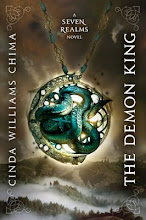
In The Demon King, reformed thief Han Alister wants to earn a living for himself and his family without returning to the gang life. What’s in the way? It’s really hard to make a living in Fellsmarch, because of the ongoing wars, he’s been accused of a series of murders, his mother thinks he’s demon-cursed, and the most powerful wizard family in the Fells is out to get him.
Usually, a book begins with an inciting incident. In The Demon King, Han Alister encounters three young wizards setting fire to his hunting grounds. He takes an amulet from one of them, and that brings a whole load of trouble down on his head.
I think it’s best to begin your story in scene, with characters on the stage, ensnaring us in their story.  The opening of your story should establish voice and point of view, introduce conflict, and make a promise to the reader about the story to come.
It may be helpful to try reading opening scenes in books in your genre. How does the author begin? What does he or she choose to include, right up front?
As I said in my post on plunging vs plotting, you don’t have to have everything figured out in order to begin. Just know that there may be considerable clean-up at the end.

Tuesday, May 18, 2010

The New England SCBWI Conference or Why Writing is Like Dying

I spent the weekend at the awesome New England SCBWI conference. Mostly fielding reactions like, “You drove ALL the way from OHIO? Don’t they have conferences in Ohio?” (Typical East Coast attitude.)
It was rather rash. You see, eleven hours in the car didn’t sound so bad three months ago, at registration time. It looked kind of misty and romantic, like a far-away, blurry photograph of yourself. I thought, “Road trip! I’ll be driving through the Berkshires in May; how lovely!” And it IS lovely. But still a long way. Even with the Rent soundtrack blasting through the speakers.
I ran into Paula Kay McLaughlin at the luncheon buffet. She lives in Connecticut, but I first met her at the Central Ohio SCBWI conference, where she was busy explaining why she’d driven all the way from Connecticut to Ohio for a conference. “Don’t they have conferences in Connecticut?”
This is Kindling Words East territory, so of course I saw lot of my writing buds from there, including Kathleen Blasi, Sibby Falk, and Toni Buzzeo. Some of us still smell like woodsmoke. Kathleen and Sibby and I celebrated by getting lost in the twisting roads surrounding the Fitchburg Courtyard by Marriott. As Sibby said, “Lock the doors! I think I hear the banjos starting up.”
Here are Carolyn Scoppettone, Libby, and Kathleen in happier times.

I finally met online friends Jo Knowles and Stacy DeKeyser in person—yay! They were both on faculty for the conference.
Made lots of new friends at dinner Friday night

and rubbed shoulders with Cindy Lord at dinner Saturday night. Maybe some of her Newbury-worthiness will rub off on me.

Lest you think I spent my entire time eating, Cynthia Leitich-Smith’s keynote was incredible. That girl has the Native-American equivalent of chutzpah. She told the story of her journey into print. She was living in Chicago and working as a lawyer when an epiphany hit—she wanted to be a children’s writer. At this point she had absolutely nothing on the page. So she and her husband both quit their jobs and moved to Austin. Two years later, Cynthia published her first book.
Cynthia and I put our heads together after her interview on Sunday. Actually, I was hoping some of her chutzpah would rub off on me.

In Liza Ketcham’s Dialogue workshop, we organized into groups of three and wrote a scene together, each contributing a character that was voiced by another group member. Our group ended up crafting a scene involving a wizard, a gossip girl, and an eleven-year-old boy with a disabled brother. I came away convinced that I am unlikely to survive a collaboration.
I also attended the presentation on school visits offered by Cindy Lord and Toni Buzzeo. Cindy had great suggestions for dealing with teens reluctant to share their work. And Toni’s strategies for managing active children in the classroom were golden. Let me tell you, anyone who acts up in Toni’s workshops has no idea what he’s in for.

When the conference was over, the hotel emptied out quickly. I stayed overnight so I could leave early in the morning. Still resonating from our comingled spirits, I sat in my hotel room and drank wine and wrote. As my husband would say, something I could easily do at home.
And, maybe it was weariness, or the wine, but it occurred to me that writing is like dying—in the end we are always alone with that page. But our writer and illustrator friends are like a choir of angels, singing us into heaven.