Thursday, April 29, 2010

Back In the Hills


We spent last weekend in Asheville, NC. When we invited my son and his girlfriend to come along, Eric said he’d heard that Asheville was a hangout for  hippies. I said, great, I still have a few tie-dyed and fringed items stashed away somewhere.
These days tie-dye is made in China and shipped around the world. Except, maybe in Asheville. Like Boulder, Colorado, Asheville is an anachronism, an eddy in time where children of the 60s and 70s might feel at home. Except they’d wonder about the cell phones. And the iPad we saw in a coffee shop.
Asheville has good intentions—there are green remodeling companies and a food co-op, dog-friendly stores and restaurants, and signs in all the store windows downtown—Thank you for buying local.
There’s money in Asheville—the woman in the yarn store said people move there from San Francisco and New York City and build mansions and castles in the mountains. But it’s still laid back and frayed around the edges enough to suit me. Even if some of the fraying is factory-applied, like the jeans you buy already faded.
It is an odd mingling of commune and company town. When George Vanderbilt chose the area for his “country estate,” it was just a little crossroads. He put up the largest private home in America, then constructed Biltmore Village, with houses, a hotel, a church, and a hospital, so when his friends got off at the train station they wouldn’t be in the middle of nowhere. The Vanderbilt descendants still own the house and are the number two employers in the area. They are also major real estate developers. Everyone we talked to had only good things to say about the family. 
We stayed in a condominium in the former hospital in Biltmore Village. With its rollerskate-worthy hallways and oversized public spaces, we felt like guests in somebody’s mansion.
While we were in Asheville, the town was abuzz because President Obama and his wife were visiting for the weekend and staying at the Grove Park Inn. Everywhere we went we heard reports of Obama sightings.            
 We walked into Malaprops Bookstore, and found a small shrine of Obama-related books near the front door. Likely, they’d heard about his visit to indie Prairie Lights Bookstore in Iowa City, where he bought books for his daughters. 

 “Word travels fast,” I said to the clerks in a clothing store on All Souls Crescent.
“Cell phones, you know,” they said.
They were right. Asheville may be the biggest town in western North Carolina, but it’s still somehow a small town. Me, I’m always too much in a hurry. I forced myself to slow down and visit and listen.
We tried to get into the Corner Kitchen Restaurant for dinner Saturday night, but there was too long a wait and we had to make an 8 o’clock curtain for Rent at the Diana Wortham Theater. So we made brunch reservations for Sunday.
We found out later that President and Mrs. Obama ate dinner there Saturday night after enjoying a private tour of the Biltmore House. On Sunday, we heard he was meeting with native son Billy Graham.
“I don’t know why he wants to do that,” the clerk in a gallery in Biltmore Village said. “I haven’t forgiven Billy Graham for the Nixon tapes.”
Huh? I thought, but kept quiet.
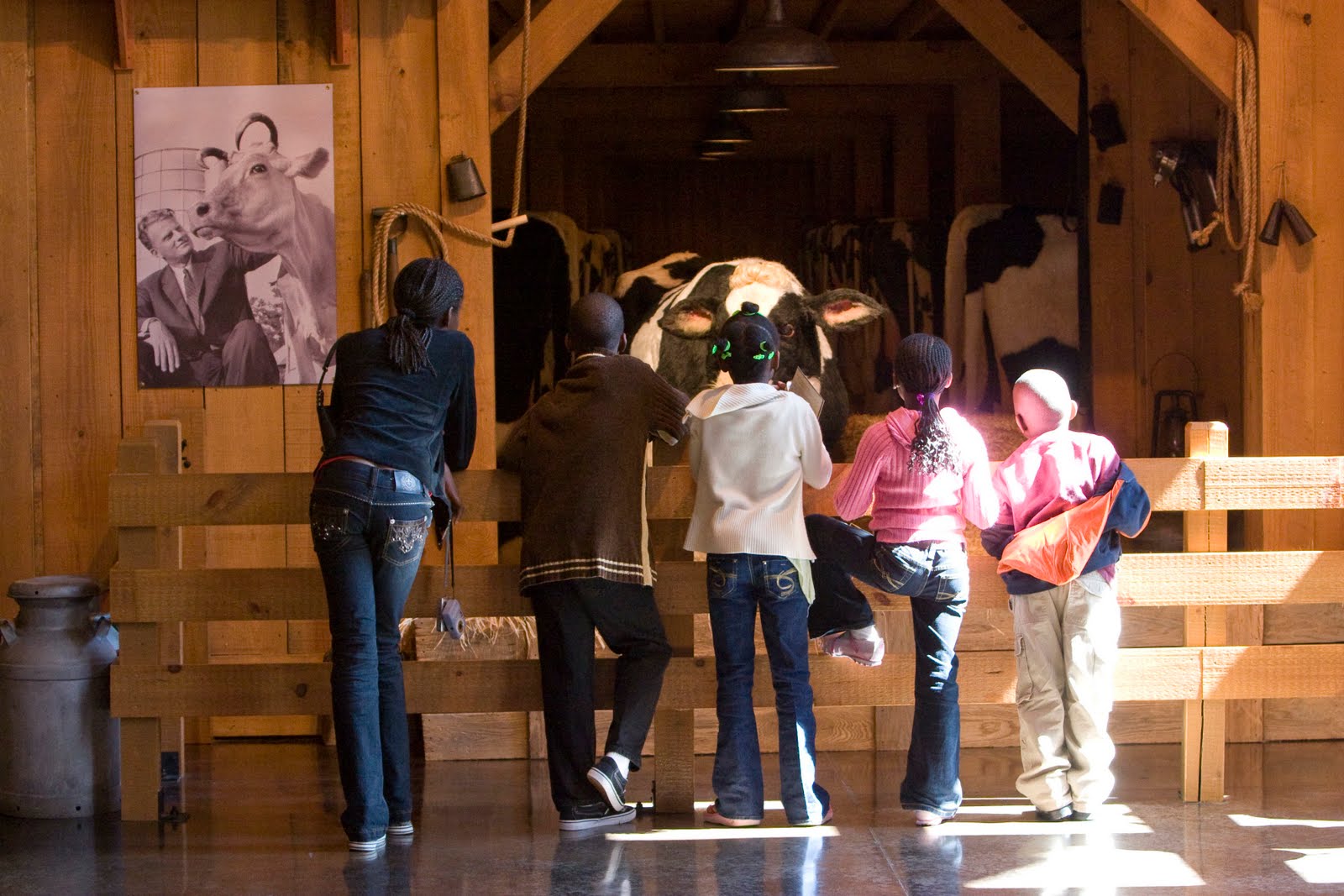
 “You know, out there at the Billy Graham Library, Billy’s son Franklin put in those awful talking cows,” she went on.
“Talking cows?”
“They’re the tour guides. Talking mechanical cows, can you believe it? If Ruth were still alive, she’d want nothing to do with that. As it is, she’s probably rolling in her grave. But they spent too much money on them, so they had to use them.”
“Ah,” I said. 
We drove to Chimney Rock State Park, which is a lovely hairpin curve kind of drive along the Rocky Broad River. We couldn’t take the elevator up to the top of the chimney, because we had a dog along. So we walked up, through groves of blooming mountain laurel. From the top, we saw hawks soaring below us, over quilted green tree-tops in spring colors, Lake Lure in the distance. We walked down to Hickory Nut Falls (gorgeous). And then back up to the parking lot, leaving my legs rubbery and tingling and my senses satiated. 

There’s something about the mountains that soothes my soul and inspires the writer within. The mountains are full of stories—cautionary tales about romancing the wrong person and strangers at the door. The music is homegrown poetry, stories set to music, classic tales of love and loss, gambling and murder and the imperfect people I fit in with so well. Some people pay for their crimes (Tom Dooley, Geordie, Omie Wise) and others get away with them (Pretty Polly, That’s What You Get for Loving Me.)  That’s the way of the world.
I think a love of the hills is hardwired in me—my ancestors came from hilly places, some of them from North Carolina. I feel cradled by crinkled land, sheltered in the smoky shadows of the worn-down peaks of the Appalachians. Even though I’ve never lived there myself, it’s home.


Saturday, April 17, 2010

Chima's Rules for the Writing Life

OK, in my last post I shared Ten Rules of Fiction Writing related to craft. Today I’ll post my rules for The Writing Life.

ON THE WRITING LIFE
1. Don’t be a writer unless you absolutely have to. To paraphrase Red Smith: Writing is easy; all you have to do is sit down at the keyboard and open a vein.
2. Nothing really happens until you put your butt in the chair and get the words down. If everyone who wanted to write a book actually did, the earth would be denuded of trees.
3. Never read your work once it’s published. There will always be something you wish you’d done differently.
4. Three hours on the Internet can save you a good ten minutes in the library.
5. If you cannot make a living through writing alone, find a day job that will not suck the marrow out of you.
6. Figure out when your best writing time is, and spend it writing, not Googling yourself, watching Cash Cab or researching agents.
7. There are too many arbitrary divisions in fiction—between young adult and adult lit, and between the genres and so-called “literary fiction.” All good writing has more in common than you think.
8. Never judge a genre by its worst example.
9. Don’t believe your best reviews—or your worst reviews.
10. Not everybody is going to like what you write. It doesn’t matter how good it is.

There you go. When it comes to sex and similes, you’re on your own.

Thursday, April 15, 2010

Ten Rules of Writing Fiction


Recently the Guardian newspaper asked established novelists to share their Ten Rules of Writing Fiction. Twenty-eight authors responded with guidance on everything from adverbs (a mortal sin) to sex (abstain from sex and similes) to travel (Margaret Atwood suggests that you take a pencil to write on “aeroplanes,” since pens leak.)  Philip Pullman rather snippily said that his main rule is to say no to requests that take him away from his proper work.

And I got to thinking: I teach a lot of writing workshops, and I correspond with many young and newbie writers. Wouldn’t it be efficient to be able to sum up all of my wisdom in a few key rules? Is it even possible? Could I tell you all you need to know about writing in ten Tweets?

OK, I’m a fantasy writer. Ten rules is so not enough. With ten rules, I’m just clearing my throat.

Let’s begin with craft, and I’ll follow on tomorrow with ten rules for The Writing Life.

ON CRAFT
1.     If you get your characters right, they’ll write the book for you while you cheer them on.
2.     The most important thing to know about your characters is what they want, and what’s in the way.
3.     Be kind to yourself when you are writing a first draft. It’s a scary business.
4.     It’s always best to write a first draft when the editor in your head is asleep.
5.     When it’s time for revision, shake her awake and give her a strong cup of coffee.
6.     If you want to be a writer, you’d better learn to love revision.
7.     You can learn a lot about writing novels from the movies. In a movie, story is delivered in scene, through action and dialogue. There’s no author getting in the way, explaining what needs no explanation.
8.      Trust your readers and give them room. Readers and writers are partners in story—both contribute to the final work.
9.     In real life, we get to know people through what they do and say. Allow your readers to get to know your characters in the same way.
10. It’s not about the idea. It’s about the execution. Really, it is.

Saturday, April 10, 2010

Meet Me at Lorain Public Library Main Branch!!


Date: Wednesday, April 14, 2010
Time: 2:30 PM to 3:30 PM
351 Sixth Street
Lorain, OH 44052
Phone: 440-244-1192

This free one-hour program is sponsored by Lorain Public Library System in celebration of National Library Week. Preregistration is required by calling the Main Library at 440-244-1192 or 1-800-322-READ, ext. 246.

And shout out to Children’s Book World and Friends’ Central School near Philadelphia, PA

Thanks to Sarah, Heather, Janet, Hannah, and all of the Children’s Book World Staff for an awesome visit!
And thanks to Teri and Penny and all the students at Friends’ Central School for hosting me so graciously there!

You all rock!

Tuesday, March 30, 2010

Never Too Late

My posts are often targeted at young writers—the ones that contact me most often with questions. But today I’m talking to writers of a certain age. Yes, you. You may not even be that old—but you’re old enough to ask yourself whether it’s too late to become a writer.
If this doesn’t apply to you—well, then, go write something!
All of my life I have been transforming myself, and each time I did, I asked myself, 'Am I too old to be doing this?'
Even when I was only 27, and thinking about going back to school to become a dietitian. I wondered--should I spend three years in school at MY age? And I thought to myself, in three years, you'll be thirty, whether you do this or not. And so I did it.
I began writing in third grade, and continued through high school. But I got away from the writing habit in college, when I was buried under school work and a nearly full time job. I wrote term papers and case studies and eventually papers for professional journals. But I left poetry and fiction behind.
I got back into writing as a working mother of young children. I was still busy, but I had something to say. I found out that I still had a lot to learn. So I made time to write and learn my craft.
Eventually, I became a fairly successful freelance writer. But I knew that freelance writing would always be a part-time gig, and I longed to go back to fiction. So about ten or twelve years ago, I made a conscious decision to focus on novels. Given that I also had a day job, it meant giving up some freelance work. And I asked myself, "Am I too old to be doing this?" But I did.
I published my first novel four years ago, and I’ve released a book a year since then. I have been a full time writer for two years now.
In my opinion, it’s never too late to transform yourself, if you focus on process instead of outcome. Writing isn’t like ballet--it’s never too late to begin. I intend to keep at it until they pry my cold, dead hands from the keyboard.
What you shouldn't do is wait until the perfect time to do it. There are easier seasons in your life to launch into a new endeavor, but there will never be a perfect time. So don't wait until you finish school, until you retire, until the children are all grown, until your life magically untangles itself. It takes time to become the best writer you can be. Start now.
On the one hand, I know I will never live long enough to write all my stories down. I regret that. On the other hand, maybe that’s how long it took to gain the skill and life experience I needed to be the writer I am.

Sunday, March 28, 2010

Shout-Out and Thanks to OCTELA


I had a great time in Columbus at the OCTELA (Ohio Council of Teachers of English and Language Arts) conference. Believe me, it is stressful to get up and make a keynote speech in front of a whole room full of English and language arts teachers and reading specialists. But they gave me a warm welcome. I always feel in context with people who love books.
 Karen Tollafield, the conference coordinator, and her committee did an awesome job. Here I am at the signing table with the raffle in the background.  

 YA author Sharon Flake, storyteller Kevin Cordi, author/teacher Steven Layne, and I did a roundtable session (though here it looks more like a lineup!) 
 Sharon was the keynote at lunch, and I attended Kevin's breakout on using storytelling in the classroom. I love hanging with authors and teachers.

Saturday, March 20, 2010

ON MENTORSHIP

Young Writer Writes:
Why aren’t more successful writers willing to mentor others? I mean, no offense, but we could use some help.

No offense taken. I have been where you are. This is a heart-breaking, frustrating business.
I think most writers do mentor others in a way that allows them to meet their other obligations. But what they can do may not match up with what another writer needs, wants, or expects.
I'm fortunate enough to be a full time writer (finally.) Believe me, I AM SO FRICKING HAPPY TO BE ABLE TO MAKE A LIVING AT THIS. Most writers—even published writers—have day jobs and many have families. For my first twenty-three years as a writer, I had a day job. I got up at 4 in the morning and fell asleep with my face on the keyboard at night. And then I used to hike three miles in my flip-flops through waist-high snow to the mailbox to mail off my manuscripts. Only to be blown off by publishers and agents alike. Year after year after year. With no guarantee that I would ever make any money.
I did get some help from other writers along the way, but it was mostly a reciprocal kind of thing—through critique groups, conferences, and blogs. I gave, and I got, and we all learned together. Participating in the community of writers is extremely important, if only because you will finally fit in.
I have learned the most from reading other writers’ books. That’s the best kind of mentorship. Reading really good books is like taking a workshop with a master—for free (if you get the book at the library.) But you have to learn to read like a writer, which is very different from pleasure reading.
I also read many, many books on craft. I have a shelf-full over my desk and still refer to them from time to time.
Many aspiring writers believe that published writers have more power than we do. My opinion is just that—one opinion, one set of biases. I’m not an editor—I’m a writer. Editing is a very different skill, believe me. In my one editing gig, it was always easier for me to rewrite something than to edit someone else’s work. That is not the kind of help you need.
I still work seven days a week (I’m trying to change that) but I do try to give back., while protecting my writing time. I blog on writing technique, teach writing workshops, do school visits, and try to answer emails from writers, either directly or through the blogs. I belong to three critique groups, one online, the other two in person. That’s what I can do, and meet my deadlines, and give my honey a hug now and then.
What most writers can’t do—for a multitude of reasons, legal and otherwise—is read your manuscript, edit it, and get you an editor or an agent. We can’t give you the magical shortcut to publishing success. Trust me—If I knew what that was, I would have used it myself.