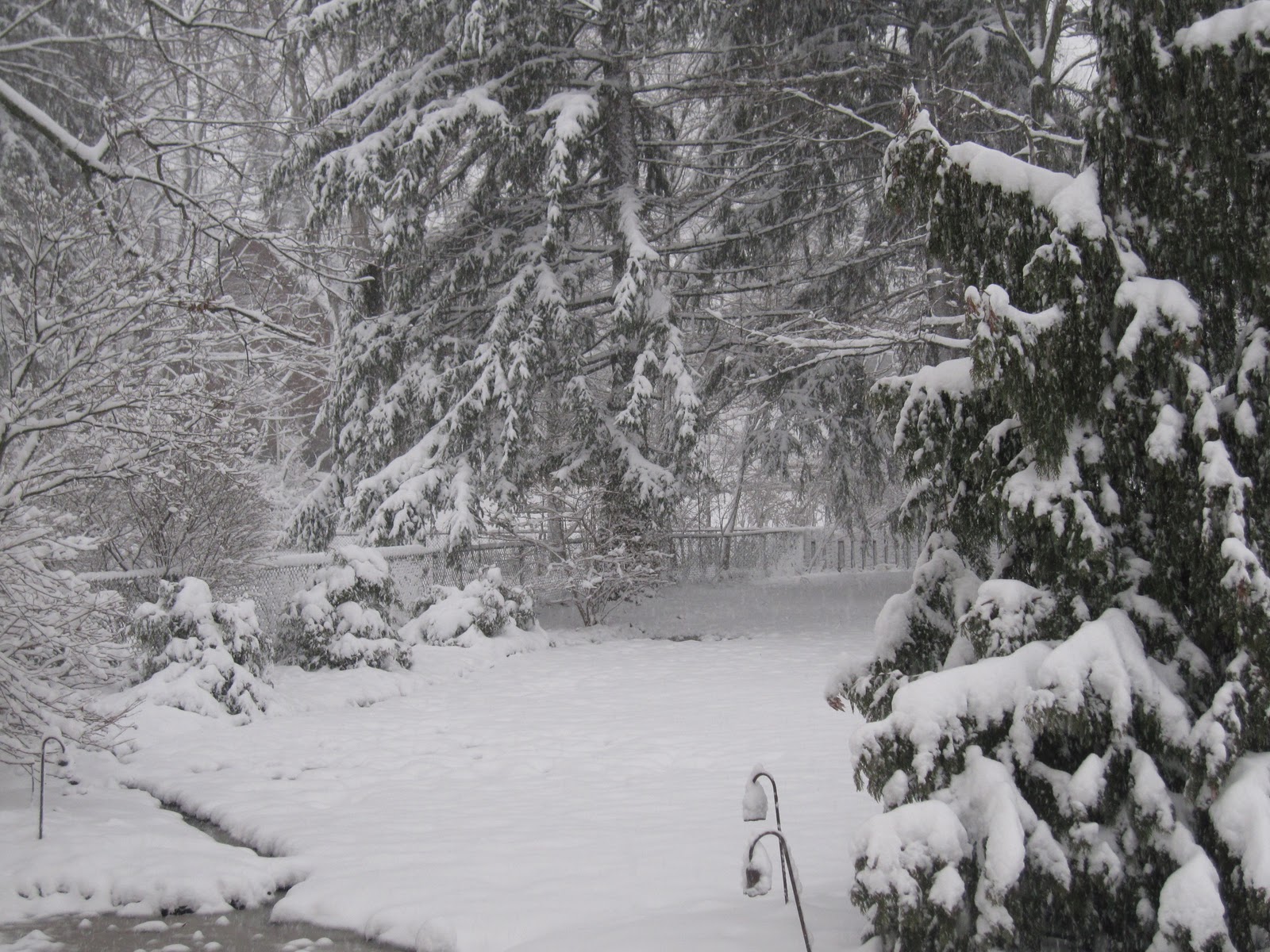
I live in northern Ohio, which for some reason isn't known for its great weather. In fact, we have great weather for, well, most of the year. For instance, today it's sunny and breezy, 75 degrees, and I'm sitting on the side porch drinking iced tea and I can't think of too many places where the weather is better than this.
We don't get credit for that.
When friends and family move away to what they consider to be a better climate, they tend to monitor the weather back here. Then, during one of our especially nasty winter storms in January, they call up and say, "Hey! How's the weather there? I hear it's really awful." Even though I don't ask, they say, "It's 80 degrees here, gonna play a little tennis later on. So glad I don't have to go out and shovel! HaHa, loser." Well, maybe they don't say "loser," but that's what I hear.
I've found there's no winning this weather game. Even when the weather is bad there, it's better than here.
When it's 115 degrees there, you say, "It's a dry heat."
When it's 25 below, you say, "At least it's sunny."
When a blizzard blows in out of the Rockies, you say, "It never lasts very long around here."
I guess I have some options. In mid summer, I could call up and say, "Hey, I hear your whole state is charred to a crisp! It's really green here, just brought in another armload of flowers. Well, I'll let you go, you better go out and swat some sparks and hose down the outbuildings again." Or during the hurricane, I could call and say, "How's the weather? I heard you were having some trouble. What? I can't hear you, sounds like it's blowing up a storm. Yeah, it's pretty calm here. Still got our siding and everything."
Or I could email a link to this great new tarantula and scorpion repellant I came across. Thought you could use this. Us? Yeah, here we had a bit of an ant problem in the spring. Nothing like YOUR ants, a course.
But I wasn't raised that way.
When I was in high school and
college, I worked in the classified phone room at the Akron Beacon Journal with
a mélange of people. Some were lifers—the full-timers, with contract accounts
and a desk name. Miss Allen. Miss Dodge. Miss Jackson. Others were part-timers,
usually women on their way to somewhere else. Since we only met customers over
the phone, the dress code was flexible for the times.
One of my co-workers was Lucine, a
whip-thin girl with quick hands and a brilliant smile. Though she hadn’t much
money (none of us did) she always looked fine. Right down to her dry-cleaned
jeans.
I couldn’t get over that. “You
don’t dry-clean jeans,” I told her.
“Why not?”
“Well. That’s the whole point of
jeans.”
“I like the way they look. And that
way I don’t have to iron them.”
“Iron? There’s no ironing of
jeans!”
In my teens and twenties, jeans
were my uniform, my go-to wardrobe item. Something I could wear until they
stood up by themselves, then throw into the wash with the hottest possible
water.
Each time they would emerge a
little bit softer and easier on the eyes. Friendlier to my body. More and more
mine. I’d wash them and wear them until they were a second skin; until the hems
became frayed from walking on them. Made shabby by love.
It was bad enough when pre-washed
jeans came along, all soft colors and manufactured shabby. No longer did you
have to put in your time with board-stiff blues to get there.
So recently I got me some of those
miracle jeans that are supposed to make you look five pounds thinner and three
inches taller. They were comfortable as soon as I put them on, so I went out
and double-dug my garden in them. When I went to toss them in the wash, I
happened to notice the care tag.
MACHINE WASH COLD DELICATE CYCLE
SEPARATELY DO NOT BLEACH HANG DRY USE COOL IRON IF NEEDED FOR BEST RESULTS DRY
CLEAN
Never mind the COOL IRON IF NEEDED,
since I knew from the start that NO ironing was needed. But DRY CLEAN? DRY
CLEAN blue jeans?
What is the world coming to when a
person can’t rely on a pair of jeans to survive in the wash?
Ever have those days when you feel like you’re being, well, crapped on? No, I mean, literally.
Today we visited the Rio Grande Nature Center State Park in Albuquerque. As we were crossing the parking lot, I noticed that a large painted turtle was crawling under the wheels of a car. I picked it up, meaning to set it down in the grass alongside the parking lot. And it peed on me. Really peed. I mean—it gushed all over my camera and my hand in the few minutes it took to carry him to the roadside. I’m sayin’ that turtle must’ve been hollow with the entire inside filled with turtle pee.
My husband found this totally amusing until I asked for his handkerchief to wipe off my camera.
No good deed goes unpunished.
And then later we went to the Albuquerque Biopark (zoo.) At the lori display, this very engaging lorikeet hung on the front of the cage, seeming eager to get my attention. I came closer. He stuck his tongue out at me. Intrigued, I came even closer. Then he projectile pooped on me.
I didn’t even know such a thing was possible.
After that, I was paranoid. I’m thinking kamikaze hummers.
So in my last post, I noted that there’s always some flaw you overlook when you’re shopping for a house.
Here, in my beautiful stone cottage by the falls, it’s stumps.
Yes. Stumps.
Every place I want to plant something, there’s a stump in the way. There’s the pine tree that got blasted by lightning at the rear of the yard. There’s the remains of the taxus hedge that lined the walkway. There’s the arborvitae and bayberry stumps along the driveway. There’s a stump in the middle of the circular bed where the summer bulbs are to go.
And there’s the massive stump under the rose garden.
Well, it isn’t a rose garden, yet. And may never be.
The bed is sandwiched between the driveway, the patio, and the house. Though the dirt was rich and black, it was a nearly vacant canvas, ready for my gardener’s touch. I blessed the previous owners, who must have brought in a load of topsoil to create this lovely raised bed.
I imagined myself on some future summer morning, sitting on the patio, enjoying the fragrance and color from my adjacent rose garden, miraculously free of blackspot and Japanese beetles.
I’m a writer. I have a very good imagination.
So one morning I spread compost over the top of the bed and dug in.
Thunk! My shovel struck wood about six inches below the dirt. I moved six inches to the right. Thunk! A foot to the left. Thunk! I dug down far enough to see reddish wood.
I consulted my neighbor, who’d lived next door to the house for decades.
“There was a tree there,” she said. “It was a beautiful tree, with lovely pink flowers. A cherry tree, I believe. Don’t know why they cut it down.”
I went to call the tree man.
He looked the situation over. “Do you have to take it out?” he said, with the wisdom of experience. “Can’t you just plant over it?”
I imagined years of thunking into wood.
“No,” I said. “I want it out.”
He promised to return the next week to chip it out, but asked that we expose the entire stump in the meantime.
Expose the stump? Sure thing. That’s the easy part, right?
After a long day of digging up beds and planting perennials, I returned to the rose bed and began to dig. Thunk! Thunk! Thunk! In a wider and wider circle.
I piled dirt on the edges of my growing hole, and then had to shovel the same dirt again when I realized the stump extended further than I’d thought. In fact, the entire bed was a stump with a thin layer of topsoil on top.
After a while, my husband joined me and we dug in sweaty, strenuous silence, punctuated by the occasional groan and extravagant curses directed at the previous owners who’d left us this little surprise under the flower bed.
It had been a behemoth tree. A tree folks would drive miles just to see. A tree whose roots must extend clear through the world, to annoy Chinese people on the other side.
Better if it were a coffin, or a corpse. Then we could call the police, and THEY’D dig it up.
After a bit, I ventured, “I don’t think I can do any more.”
My husband kept digging.
“Don’t you think this is good enough?”
My husband kept digging.
“The next house we buy, I’m gonna walk around the yard with a long stick, and probe into the dirt, and see if there are any stumps,” I said.
He gave me a look.
Oh. Right. Our next house will be a stump-free condo.
I'm not exactly a technofile, but I have become accustomed to accessing information and communication at the click of a mouse. Before we moved into this new house, my husband contacted our cable provider online to arrange transfer of service. Good news! the email reply said. You're still in our service area! A service rep will contact you to arrange transfer of service.
On moving day, we half-expected someone to show up from the cable company, but no one did. But when we set up our modem, routers, etc, lo and behold, we had Internet and digital cable access! How easy was that? we thought.
Too easy. After three weeks in our new home, I returned home one day to find the cable dead.
I called the technical help line and went through the annoying numerical menu, plugged and unplugged the modem, and finally hacked my way through the electronic thicket to find a real person.
"Our cable seems to be out," I said, with the confidence of the righteously wounded. I knew that they would rush right out to fix it. But when I gave my information, it became clear that we were still listed at the old address.
"How can that be?" I said. "We sent a request, and we've been online for three weeks at our new address."
Apparently they did some kind of audit and discovered unauthorized cable service at our new address. They disconnected it at the street.
"I need Internet," I said, in the manner of someone whose oxygen has been cut off. "Turn it back on."
"The soonest we can come is Wednesday," Cable Guy said.
"I'll be in Columbus Wednesday," I said. "Can't you come tomorrow?"
"We're booked up tomorrow," he said. "Are you sure you can't be there on Wednesday?"
Sure. Okay. I just made up that Columbus story.
"No.I.will.be.in.Columbus.Wednesday," I said.
"Well, we can try to force it in," he said.
"What?"
"Are you home now?"
"Ye-e-s."
"I can try to force an appointment for tonight," he said. "No guarantees."
"Are you saying somebody might be here tonight to turn on my cable?" Hope kindled.
"No guarantees."
"When will you know?"
"Well, uh..." he said evasively.
"I can't watch TV or get online, so I thought I'd get into the tub," I said.
"Uh..."
I know. TMI. But it soon became clear that nobody was forcing anything either tonight or tomorrow.
"So," he said brightly, "were you satisfied with this service call?"
"Well, I'm not satisfied that I don't have Internet access or TV, but I think you did your best to help me," I said generously.
"Well, in that case, had you thought about switching to digital phone service, too?"
Many possible responses crowded into my mind., but I chose the high road. "Um, no," I said.
"Don't you want to save money?" Cable Guy asked.
"No," I said testily. "I'm actually looking for ways to squander it."
It's all about timing, Cable Guy. It's all about timing.
I woke up this morning to find a dumpload of snow on the ground and more coming down.Who says April is the cruelest month? I’m thinking March—around here anyway.
Just a few days ago, I walked the perimeter of my yard, planning borders and beds and vegetable gardens, watching the pattern of sunlight and shadow shift across the winter-beaten lawn, breathing in the voluptuous fragrance of thawed earth.Spring was coming. I mean, it’s always come before, right?
I dragged on my parka, and my boots, and slid my laptop into my backpack to protect it from the elements, grumbling the whole time. I am tired of the winter rituals—the ordeal of going outdoors. I want to pass easily from interior to exterior spaces without putting on my shoes, without layering on clothes, without scrunching up my body to reduce wind resistance. I want to come inside without peeling.
I envisioned putting an ad on Craigslist. “End of Season Sale! A foot of freshly-fallen snow, primo packing quality. Easily attaches to shrubs and trees. You shovel or will deliver to warm and sunny climates.”
And yet. The backyard was transformed, as only a snowstorm can do, each sharp edge blunted by moguls of snow, all blue shadow and white crystalline surfaces, punctuated by shots of evergreen and the brilliant red of cardinals bickering over the feeder.
I walked downtown, navigating the obstacle course of snowplow leavings and unshoveled walks.Snow found its way into the tunnel of my hood, collected on my eyelashes and shoulders.
The river flowed like a dark ribbon, flecked with snow and foam, between glaceed trees. The sounds of civilization were muted, the reflective surfaces shrouded in snow, every ugly thing covered over, temporarily, at least.
It’s like that old boyfriend that’s caused you endless hassle, and you’re just tired of dealing with him. And, yet, when you see him, he looks so fine.
All right, I thought. I may be a fool, but I’m giving winter one more chance…
Well, it’s time once again to beat the dead horse of book piracy. I just visited a site that features all of my published books—total downloads, 9042.
Have a question in your mind about whether book piracy really hurts authors? Two authors recently posted about the direct effect piracy is having on their careers.
In this post, author Saundra Mitchell explains how her failure to earn out her modest advance on her first book, Shadowed Summer, made it nearly impossible for her to sell a second one. Not that the book isn’t popular—on one site alone thieves are downloading 800 copies a week.
Kimberly Pauley, author of Sucks to Be Meexplains the direct impact illegal downloads (22,000 on one site alone) have had on sales of the second book in her series. Her publisher won’t authorize a third book because actual sales of the book haven’t been strong enough.
Who steals books? Probably people I would like if I met them—fellow book-lovers. It breaks my heart.
Think—if book piracy is a victimless crime, would so many authors be complaining? Do you think it’s just money out of the pockets of millionaires? Guess again. Most authors don’t go into this business to earn a fortune—but if they cannot make a living, they will have no choice but to turn to something else.
If you want to see more books from your favorite authors, please think twice before you illegally download a book. Confront piracy wherever you see it. And let your friends know you don’t approve.
Some long-time readers may remember my post about spending the night in what I called the American Airlines Holiday Inn (a baggage cart in LaGuardia Airport.)
This week, I flew to New York City for a memorial service for literary agent Ralph Vicinanza. When I booked my flight, a direct flight to NYC would have cost $750. A flight that connected through Philadelphia cost $250.
Not a difficult decision, based on cost, but, still, I hesitated. I knew if I booked a connecting flight to the east coast in December, I would live to regret it. But I did it anyway.
When I flew out of Cleveland, it was snowing like crazy, the local phenomenon we call “lake effect.” After serious de-icing, the plane still took off almost on time. We know to expect snow in December in Cleveland.
All went well until the return trip. I was at (you guessed it) LaGuardia Airport, this time flying U.S. Airlines. Mind you, there was no bad weather at LaGuardia, or in Philadelphia, where I was headed for my connection. But there were delays and cancellations all over the flight board.
How You Know You're Not Gonna Fly
First, we had no plane. So they switched me to a flight that had a plane. Then we sat on the runway forever because of air traffic, making us late enough to endanger my connection. As we deplaned in Philadelphia, they handed us boarding passes for rebooked flights the next morning—just in case we missed the flight to Cleveland.
That should have been a clue. Still, three of us heading for Cleveland raced to take the shuttle bus to the next terminal. We arrived at our gate all in a lather, only to find the gate deserted. Our plane had just left.
Together with another passenger named Sue, I headed for the US Air service center, hoping we could still get out that night on another airline. The genial man at the service counter said, “Oh, no, all the airlines stop flying at the same time. There’s no more flights tonight.”
“Well, then,” I said, not looking forward to another night on the floor, “Could you put us up for the night? I mean, this isn’t our fault.”
“Depends on the reason for the delay,” he said, clicking through screens on the computer. “Nope,” he said, shaking his head mournfully. “The delay was due to air traffic. We don’t pay for air traffic delays.”
I don’t get that. If there’s too many planes in the air at once, the airlines put them there. They schedule so tightly at hubs on the east coast that any minor perturbation throws the schedule into a tailspin. Figuratively speaking.
Just as he got done explaining this, Sue began to cry. She had children to get to school the next morning, she didn’t know who was going to be able to pick her up at the airport, and, clearly, she didn’t want to spend one more minute in Philadelphia.
I could totally relate. I cry when I’m angry and frustrated, too.
As Sue went to get a tissue, the supervisor at the next terminal asked, looking worried, “Is she going to be all right?”
“I don’t know,” I said, shaking my head. “We just met.” My expression said, She looks awfully fragile to me.
The supervisor turned to the clerk. “Give them a voucher,” she said abruptly.
“What?” he said. “But…”
“Give them a voucher,” she repeated, turning back to her screen.
And so it was that I stayed in the U.S. Airlines Ramada Inn. And slept in a bed.
I’ve noticed something disturbing as I criss-cross the continent—people seem to have developed a widespread, persistent fear of handrails.
For example, I am in Acadia National Park and we are descending a steep stairway to Thunder Hole, where the ocean crashes into a narrow passageway, spewing high into the air.
Seems like a place where handrails would be a good idea, right?
I observe a young girl reaching for the handrail to steady herself.
“Don’t touch that!” her mother bellows, grabbing her daughter’s arm and yanking it out of danger.
Days later, in Quebec City, we are climbing the long staircase from the Rue du Petit Champlain to Haute Ville—a staircase aptly named Escalier Casse-Cou, or the Breakneck Stairs. Again, a child innocently takes hold of the handrail, and her mother scolds her, whipping out a container of antibacterial foam and smearing it all over her daughter’s hands.
We’ve gone beyond aggressive handwashing and anti-bacterial dispensers on every street corner. These days we’re air-kissing the handrail.
Having been a recent victim of Norovirus, I totally appreciate the dangers in touching contaminated surfaces. But in a risky world, we have to prioritize. I can’t help but wonder if we’ll have an epidemic of people falling to their deaths over cliffs and down staircases and escalators.
I recently climbed the Beehive in Acadia, clinging for dear life onto those iron handholds bolted into the rock. Believe me, I wasn’t worrying about whether I might develop symptoms tomorrow. I was worried that I wouldn’t see tomorrow.
More important than fear of handrails? Fear of falling.
My opinion—handrails are our friends. With handwashing to follow.
We attended an author event at the Rathbun Library in East Haddam, CT. It opened with wine and hors d’oeuvres on the lawn.
The author spoke in the Reading Garden behind the library. He was the author of a number of mystery novels and nonfiction books about forensic science, focusing on the most lurid murders of our century, including O.J. Simpson, Sam Sheppard, JonBenet Ramsey, et al.
During the Q&A, someone asked the author whether researching such heinous crimes had given him a morbid outlook on human nature. “Some people will disagree with me,” the speaker said. “But I think rock and roll has a lot to do with what’s wrong with this country today.”
Huh?
I must confess a certain ambivalence regarding the effect of art on human behavior. It’s like I’m back in Problems of Democracy class when we had to debate first one side, then the other side of a controversy.
On the one hand, I am totally convinced of the power of art and literature to change people. On the other, people who blame art for human wickedness never fail to annoy me. The notion that a book—or a movie—or a video game—or a piece of music can derange one’s moral compass seems silly to me.
Humans were behaving badly long before rock and roll came along. People—women especially—were paying the price for unprotected sex long before the jazz age. Teens don’t learn profanity from books, as a rule—they learn it the old fashioned way—at home or on the street.
Art is rooted in experience, emotions and opinions that already exist. It can be a means to communicate between like-minded folk. It is expressive. It can crystallize and clarify. It is a medium—but it is the artist and the audience who provide content and context—the fertile ground in which ideas can grow.
Yes, art moves people. Yes, the creators of art may have an agenda. The Declaration of Independence articulated an argument for freedom on behalf of a group of educated white men, many of whom were slave-holders. The men were flawed, but their art was brilliant—so brilliant that it should have been used to argue for freeing the slaves. The flaw was in the men who created the art—not in the art itself.
In fact, art is more likely to drive moral behavior than immoral acts. What makes us human is our ability to empathize. Great art creates connections between us—it allows us to see the world through the eyes of another, and so understand.
Abraham Lincoln famously called Harriet Beecher Stowe “the little woman who caused this great war.” He didn’t really believe this—that taking out Harriet before her book was written would have averted the clash of interests, economies, and culture that caused the Civil War. But her views were representative of an ethical shift that made slavery no longer acceptable in a nation that claimed to be free.
Mark Twain continued this work in his masterpiece, Huckleberry Finn. Everything Huckleberry knows about slaves and slavery is contradicted by the reality of Jim. And the reader’s assumptions are confronted as well.
As Pablo Picasso said, “Art is a lie that makes us realize the truth.”
In my previous post, I expressed misgivings about using Lexiles to select books for pleasure reading for middle and high schoolers.
I appreciate all the thoughtful comments from people who are more expert than me in reading and library science. Thank you!! Librarians and teachers: you are my people!!
Before I let this topic go (my heavens, a 2-blog rant!) I thought I would try using the search program on the Lexile website to find books within a particular Lexile range that I might like to read. I used the grade level ranges, though I understand that standardized testing generates a Lexile level for individual students.
Let’s say I’m a 10th grader, and I find books at my grade level easy to read. That translates into a Lexile of 1155 to 1390, according to the website. I narrow my search to fantasy juvenile fiction, ages 14 and up, because that’s what I like. The result: a total of six books. Out of a huge database. They seem oddly young, too—not high interest for 10th graders. The ages ranges on the specific books are 7 and up, 8 and up, 10 and up. Examples include Tales of Beedle the Bard, Wizardology, and Arthur Spiderwick’s Field Guide.
If I search general (not juvenile) fantasy fiction, I get eight books: two H.G. Wells, one Arthur Conan Doyle, a 1983 science fiction book by James Hogan, a science fiction textbook, a fantasy textbook, an Arthurian tale, and one R.A. Salvatore Forgotten Realms series fantasy novel from 1993. Mostly science fiction, and nothing contemporary at all. It seems like the older the book, the higher the Lexile level.
Well, maybe it doesn’t work so well for high school. How about middle school?
OK, I’m a seventh grader with a high reading level (Lexile of 1040-1270.) That would be my own target reading audience. Again, I search for juvenile fantasy fiction, age 12 and up. We’re doing better. We turn up 32 books this time. And some of them have been popular with teens who self-select (Brisingr, Blue Moon, Sabriel, Chalice, Princess Ben.) But the list also includes three old Wizard of Oz books, H.G. Wells’s Time Machine, and some that look like picture books. And there is no guarantee how many of these books are going to be in a given library, or appeal to an individual reader who, say, likes urban fantasy. Fantasy is a broad genre, and this is pretty limiting.
Hmm, I think. Let’s take a different approach. I’ll look for books in a similar Lexile range to my latest book, The Demon King. Now The Demon King is 512 pages, a complex high fantasy with multiple character viewpoints aimed at ages 12 and up. It has a Lexile level of 760. Oops. According to the Lexile website, that’s equivalent to a fourth grade reading level.
This is the same book that is being published as adult fiction in several countries overseas.
Let’s see what else is in this range (660-810L), ages 10 and up.
Wow. I have a lot of competition for those fourth grade fantasy readers. I get 692 books! There’s lots of good stuff here. Tamora Pierce’s fantasy novels, Jonathan Stroud’s Bartimaeus series, Suzanne Collins’s phenomenally best-selling The Hunger Games. More best-sellers include Rick Riordan’s Lightning Thief series, Scott Westerfeld’s Uglies trilogy, Cassandra Clare’s Mortal Instruments series, Kammi Garcia’s Beautiful Creatures and Maggie Stiefvater’s Shiver, Libba Bray’s A Great and Terrible Beauty series. Also, of course, the Twilight series, and all four of my YA novels.
There are award-winners like the Newbery winning The Giver, Cornelia Funke’s Inkheart series, Jeanne DePrau’s City of Ember, Gail Carson Levine’s Ella, Enchanted, and the Best Books for Young Adults 2010 top-tenners The Demon’s Lexicon and The Reformed Vampire Support Group.
Hmmm. Here are Annette Curtis Klause’s Blood and Chocolate (ages 14-17), Neal Schusterman’s Unwind (ages 13-17) Kristin Cashore’s popular and award-winning Graceling and Fire (ages 14 and up). Some a little edgy for that high level fourth grade child.
But, keep in mind, based on Lexile level, none of these books would be offered to a high-reading level 7th grader. They wouldn’t be “hard” enough.
By the way, some picture books, including Where the Wild Things Are, by Maurice Sendak (740L) are in the same range. It’s actually at a higher Lexile level than my novel, The Wizard Heir (690L), which is 458 pages long. Who knew? And, Young Merlin, 25 pages long, for ages 4-8, is also ranked more difficult than The Wizard Heir based on Lexile.
Anyway, when it comes to pleasure reading, I’m going back to fourth grade, I guess.
OK, I’m having fun here. And I admit: it’s possible I messed up somehow, though I believe I used the search function the way any parent or child would to find a book. My point is this: it would be cool to match readers to books they could successfully read. But as soon as you develop a score, rating, numerical evaluation of something, it takes on a life of its own. People begin to misuse it, even though the developers of the system have disclaimers on the website about responsible use, considering content, etc.
Plus, I shouldn’t have to tell you this, but just because something is difficult to read doesn’t mean it’s worth reading.
Even when it comes to reading level, a formula based on difficulty, e.g. strictly sentence length and word frequency, seems limited. Also in play are the length of the book, the complexity of the story, the metaphors and imagery used, the theme, the content, the subject matter, and the pacing. I would argue that a 458-page novel is more challenging to read than a picture book, and more suited to a high level reader. I don’t care about the length of the sentences.
I freely admit, I’m no expert, just a reader and a writer and a parent. But as someone with a vested interest in nurturing pleasure readers, I’d rather have a librarian or teacher talk to the student, find out what they’re interested in, what else they like to read, and direct them on that basis. If the book is too challenging, it will take about a minute for the kid to figure it out. Trust them.
And the last thing I’d want to do is take a book out of a kid’s hands that he or she wants to read, because it’s not hard enough.
I was having dinner with some librarian friends recently. One of them was venting about a new program she was being required to implement in her high school library.
“They want me to ‘Lexile the library,’” she said. “I’m fighting it.”
“Lexile the library? What’s that?” I said.
Turns out Lexile is a scoring system used to evaluate the reading difficulty of books based on word frequency and sentence length. The idea is that if you know a book’s reading level, and you know the reading ability of a student, you can direct them to appropriate books. Nothing wrong with that, right?
“They want me to paste the Lexile rating on the spine of each book,” my friend said. “Then the language arts teacher sends students in to check out books for pleasure reading. He tells them they have to be in a certain Lexile range. I’m the one that hears the complaints. They don’t want to read any of those books.”
Hmm, I thought. That’s an odd way to choose books for pleasure reading.
“Plus the ratings don’t even offer good direction,” she said. “Take your books. The Lexile level for The Warrior Heir (L730) is higher than for The Dragon Heir (L710). Does that make sense?”
Intuitively, it didn’t. The Warrior Heir is a straightforward hero’s tale. The Dragon Heir is layered, nuanced, darker and more complex with multiple viewpoints. Also fifty pages longer. My younger readers tend to prefer The Warrior Heir. But I guess it must have longer sentences or harder words than The Dragon Heir.
Then I did an author visit at a school. During the question and answer period a teacher raised his hand and asked me, “When you’re writing your books, are you aiming for a particular Lexile level?”
I stared at him, feeling a shiver of apprehension. “You mean I have to do that, too?” I blurted.
As if it’s not hard enough to write books that teens want to read, that parents approve of, that your publisher will buy, and that you can be proud of.
Then I happened to be looking on the Barnes & Noble site. There, on the page for my newest book, The Demon King, was this entry: Reading Level from Lexile: 760L
Huh?
Barnes & Noble has made its site searchable for Lexile levels.
I was beginning to feel like I was the viewpoint character in a dystopian novel.
I ranted about this to my husband. He rolled his eyes and said, “I feel a blog coming on.”
Um, no, I don’t think about Lexiles when I write. My job as a writer is to tell a story in the most effective way. It means I try to choose the best, most vivid words and a sentence structure appropriate to the on-stage action. I’m thinking good writing--spare, streamlined, and clear—will tend to have a lower Lexile.
I went online, and discovered a whole Lexile world out there. There’s a Find a Book feature on the Lexile website where you can search for a book in a certain Lexile Range. There are success stories of schools that “Lexiled their library.” One company says on its website that its software can allow the librarian to see whether the book a student wants to check out is at the correct reading level. If not, the librarian can direct students to appropriate books. That way, the librarian can “play a big role in improving student reading and essential growth and achievement.” Wow, finally! That would have to be so rewarding, being the book police. Not only that, the software “keeps a Lexile history for each student, and their progress is trackable and, more importantly, reportable.” Does anybody else find this disturbing? It’s not the system itself, but how it’s being used that worries me. Next time: the Lexile investigation continues...
Google Alerts notifies me when one of my book titles or my name appears online. This helps alert me to reviews I’ve missed, awards nobody told me about, or mentions of my books—good and bad—on people’s blogs.
Every so often, it will turn up a link to a post on Yahoo Answers or a torrent site that goes something like this:
I LOVE LOVE LOVE Cinda Williams Chima’s books. Anyone know where I can download them for free?
Call me crazy, but I’m just not feeling the love here.
Book and music piracy is stealing. It is not a victimless crime as some people seem to believe.
I know—I’ve heard all the arguments used to justify piracy, some of them from people who wouldn’t think of walking into a store and walking out with a ham, a pair of jeans, or a physical book without paying for it. Somehow, that ink and paper book has value. The message I’m getting is that the work that I do does not.
YA authors Laurie Halse Anderson and Mary Pearson have done a good job of addressing those arguments on their blogs so I won’t repeat them here. I believe that people steal books and music because 1) they don’t view it as hurting anyone, really, and 2) they’re unlikely to get caught.
I recently was directed to a website that offered illegal downloads of three of my books. Total downloads: 781. And that was just one site. Not all of those downloads represent lost sales, but a hundred books here and a hundred books there--it adds up. And as e-readers proliferate, it’s bound to get worse, unless we—all of us—take action.
In any given week, my publisher knows just how many books of mine have sold. Guess what—if I don’t sell enough books, my publisher isn’t going to publish any more of them. I’m not a musician. I can’t take my show on the road and sell tee shirts and merchandise. Touring authors don’t draw huge crowds of paying customers. I’m not an entertainer. I’m a writer.
So I’ll have to find something else to do for a living. I can’t afford to work this hard at something for free. With a few notable exceptions, most writers—even successful ones—make a modest income. Can’t wait for the next book in your favorite series? Well, it’s going to take a lot longer if your favorite writer is working a day job. If he or she is able to write at all. I left a day job that I loved because I was exhausted.
All you aspiring writers out there: speak up now, or say goodbye to a future as a professional writer. If your friends are illegally downloading books and music, call them on it. Let them know you don’t approve.
To any pirate reading this: I know you don’t mean to, but when you illegally download an e-book, I can’t help but think you are targeting me, because what you are taking is what I contributed. The story. Not the ink and paper or the fancy binding. It may not seem real to you, but it sure seems real to me.
It takes me a year to write a book. And I hope you think it’s worth paying for.
Recently, I blogged on the topic of my new, laid-back approach to dealing with garden pests.
There is one major exception to this tolerant view—the Japanese beetle.
My feud with this voracious plant assassin goes back to the year I first planted roses. My roses looked beautiful until about the Fourth of July, when the mature beetles erupted out of the ground. I’d walk out to the garden to find my flowers covered in beetles. They seemed to have a knack for picking out the most beautiful buds, the loveliest flowers in full-blown glory—and ruining them.
Not only that, those beetles were copulating on my roses, they were coupling up and having sex while they chomped my flowers to bits. They emitted pheromones, calling their comrades to join the fun. Talk about your multi-tasking. Meanwhile, their devilspawn offspring lurked under the turf, grazing on the roots of my grass.
I tried those Japanese beetle traps, and my neighbors thanked me, because they drew all the beetles to MY yard. I crawled around my yard with a teaspoon, seeding it with milky spore to kill the grubs.With no apparent effect. Apparently you have to also convince all your less-obsessive neighbors to crawl around on their lawns, too. Or offer to do the crawling for them.
I tried systemic insect controls, even though I don’t like using pesticides in my garden. The beetles treated it like a condiment. I looked up “Japanese beetle controls” online. Nematodes were described as providing “marginal” control, and the extension service bulletin noted that milky spore “may not be effective in Ohio and Kentucky.” Nobody promised me a beetle-free future.
Anyway, it was fun looking at the pictures of nematodes invading the bodies of Japanese beetle grubs and parasitic fly maggots boring their way into the thoraxes of the adults.
Or consider our friend, the Japanese wasp tiphia vernalis. “The female wasp digs into the soil, paralyzes a beetle grub by stinging, and then deposits an egg on the grub. When the egg hatches, the emerging wasp larva consumes the grub.” HAHAHAHAHA!
I’m not usually like this.
Now that I work at home, I’ve resorted to a marginally effective but completely organic and simple approach. When I take writing breaks, I walk out to the garden, pick off the beetles, and drop them into a jar of soapy water. I don’t know what it is about soapy water that kills them, but it’s fast-acting, whereas a beetle can swim around in a jar of plain water for a couple of days. (Trust me on this.)
What’s important to you when you check into a hotel? I realize that hotels have it tough, because everyone has different expectations of what good service is. One person has no interest in Internet access, while the next demands it. One guest requires an in-room media center, while someone else is more interested in security measures.
So I’m in Los Angeles for the SCBWI Annual Conference at the Hyatt Regency Century City. Now, this is not a flophouse by any means. It’s a beautiful hotel, recently renovated. The “rack rate” is $399 a night. (Full disclosure: I am not paying that much since I’m here with a conference.)
My question is, what should you get for your $399 a night? Here is my personal list of loves and hates in hotels:
Loves I love these super beds hotels have these days. Six pillows may be a bit much, but I like being adrift on a great barge of a bed. It feels like a special privilege to sleep in one of these.
A beautiful view. It may seem silly to pay more for something you can’t take home except in your memory, but I love to look out at beauty. Those cool showers with the curved shower curtain rods. You don’t end up with the shower curtain plastered to your bare body or water all over the floor.
Free Internet access in your room. I think that should be a given these days. Ironically, it tends to be provided in business hotels for $125 a night. For $399, you pay extra to get online. A good working desk and chair with adjustable height. Right now I feel like my keyboard is under my chin. Coffee maker in my room with good coffee: I like to have coffee before I meet the public. Including Room Service Health clubs: these should be gratis. I’m not talking about a spa, but basic workout equipment. It’s hard enough to exercise on the road without feeling like you’re being nickeled and dimed to death
Hates Those in-room junk food stores posing as refrigerators. Here at the Hyatt, half the space on the bureau is taken up by a snack store with chips, cookies, raisins, and nuts. The mini refrigerator is packed with liquor, pop, candy bars, cookies, candy, and beer. There is no room for personal items I might want to refrigerate, for example, healthy items like milk or fruit or leftovers from dinner. Once again, there is a warning sign on it telling me that electronic sensors will bill my room if I disturb any of the items and warning me not to try and put my personal items in there. This is service? Why couldn’t there be a mini bar with items for sale for the convenience of guests and a couple of shelves for your own foods? That would be hospitality.
Non-dairy powdered creamer in those little packets with the coffee maker. Yick! Use real cream. It keeps for a long time in those little cups. Cardboard cups. For $399 a night, you should get real glass. (BTW. the Hyatt offers to provide real glasses on request. It took two tries to get some.)
No Big Deal Towels: I don’t care if they change the towels and sheets every day. I don’t do it at home, so why do I need it here? Hair dryers: I don’t care if they provide hair dryers. You can’t count on their being there, so I always bring my own anyway. So don’t bother. Iron and ironing board. Like I’m going to do ironing here.
What about you? What are your pet peeves and delights when you stay in a hotel?
The first time I flew on an airplane, I was in 7th grade, and we flew from Little Rock back home to Ohio. I was beside myself with excitement. I sat in the window seat next to a stockbroker from New Orleans who good-humoredly entertained an aggressively verbal 12-year-old. We were served a full meal on china, and I remember looking down on lighted swimming pools like aquamarines set into the dark landscape.
Since then the flying experience has, shall we say, deteriorated. I’ve learned to keep a weather eye when I fly to the east coast. The east coast air traffic grid is like a delicate sand sculpture that dissolves to mud whenever it rains.
Recently I flew to New York for a meeting. It was meant to be a quick trip—I took an obscenely early flight on Thursday morning, with a return flight 8 p.m. Friday night. It began raining mid afternoon on Friday, and umbrellas bloomed along Fifth Avenue like black mushrooms. I arrived at the airport two hours early. A few minutes before our scheduled departure time we were told our plane and crew were stranded elsewhere. For the next three hours we shuffled like refugees from gate to gate on Concourse C in response to announced gate changes. Finally, it seemed we might actually depart at 11 p.m. The plane was there, the crew was there—all except the captain, who didn’t show up. They couldn’t find a new captain. The dreaded announcement came over the speaker. Our flight was canceled, and we were instructed to approach the podium to reschedule.
The savvy among us leapt forward to be first in line. The mood grew ugly as the podium staff denied passenger requests for vouchers for a hotel room or even cab fare. We were told that because the cancellation was due to weather, we were on our own. No, we said. The delay occurred because of weather. The cancellation happened because the captain didn’t show. American Airlines was unmoved.
They said the soonest they could fly me out was 5 p.m. the next day. I vigorously objected. Finally, they booked me and three other women on a Delta flight to Atlanta that left the next morning at 6 a.m., with a connection to Cleveland.
I joined up with Sharon, a sales manager from the Cleveland area, and we made our way over to the Delta terminal together. The ticket counters were deserted, the walls lined with sleeping bodies, bundles and bags like the homeless on some desolate urban street. I went to the Delta office to see if I could score some of those plush airline blankets. “How many would you like?” the clerk said. “Oh!” I said, so beaten down I was expecting abuse. “You mean it? I can have more than one? I’ll have two, please.” The clerk handed over two blankets and said, “Would you like some crackers, too?”
“Crackers? I can have crackers?” Tears sprang to my eyes and I nodded mutely. It was the nicest thing that had happened to me since I left Manhattan.
Back in the gate area, Sharon and I rolled baggage carts into a corner and spread blankets over them. We joked about our slumber party hosted by American Airlines. I worried that we could be rolled away during the night by white slavers. Nevertheless, I curled up on my side, still in my skirt and jacket from my long-ago lunch, and sought sleep.
It was long in coming. Loud music blared over the overhead speakers. Cleaning staff relentlessly circled our small camp with floor polishers. Some intrepid passenger was snoring, and a child fussed nearby. I maybe slept an hour and a half.
At 4:30 a.m. the Delta ticket counter opened and we checked in. When we went back through security for the second time in two days, we were in for a rude surprise. As a last minute booking, we were flagged for “special” treatment and shuffled over into the “special” line. Our carry-on baggage was opened and searched and run through a special x-ray. We all spread our legs and raised our arms and submitted to pat-downs, thus completing the full contemporary airline experience.
By the way, this is the third time in three flights on American Airlines that my flight was canceled and rebooked for the next day. Two flights were to the east coast, and one was to Wyoming.
So what is the airlines’ responsibility to the stricken victims of flight delays and cancellations? True, the airlines don’t control the weather. But it doesn’t make sense to have a system so fragile that the slightest perturbation destroys it.